

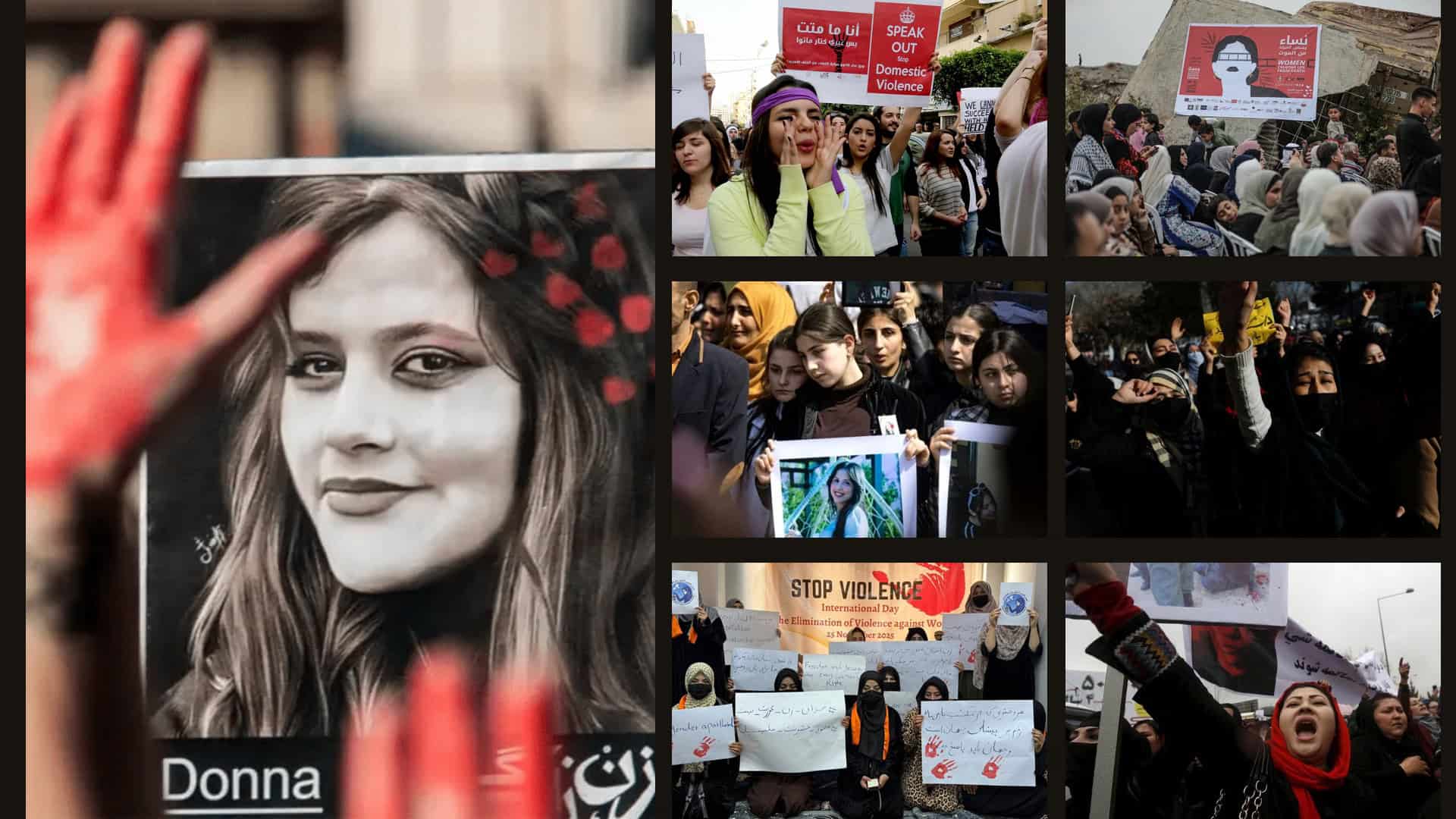
Across Southwest Asia and North Africa (SWANA), women confront multiple and interconnected forms of violence every day. Armed conflict, political repression, economic insecurity, displacement, and discriminatory laws and institutions expose women to violence in their homes, communities, and public lives. Governments frequently fail to protect women, investigate abuses, or hold perpetrators accountable.
For many women, meaningful routes to protection or justice do not exist. Survivors who report violence may face stigma, retaliation, disbelief, or further abuse. Legal systems frequently fail to protect them; institutions intended to provide support are under-resourced, inaccessible, or absent; and those responsible for violence often act with impunity. These failures are not isolated. They reflect systems sustained by discrimination, militarisation, women’s political and social exclusion, and the shrinking space for women to organize and demand justice.
War and armed conflict have intensified these realities across the region. Women and girls face sexual and gender-based violence during conflict, displacement, and detention. They are exposed to exploitation and economic violence as livelihoods disappear and access to employment, education, healthcare, and basic services is restricted. At the same time, violence within the home frequently rises under the pressure of poverty, forced displacement, insecurity, and trauma.
In Syria, women have organised for years to find out what happened to loved ones who were detained or forcibly disappeared. We stand with movements such as Families for Freedom in demanding that families be told where their relatives are and where they have been killed, and where they are buried. Women who survived detention and women searching for missing relatives must have a say in which abuses are investigated, how survivors can testify safely, and what reparations they receive.
Femicide is another urgent expression of this crisis. Across the region, women continue to be murdered by intimate partners or family members, while authorities fail to prevent these killings, investigate them effectively, or bring perpetrators to justice. In Iran, documented cases of femicide continue to reveal the deadly consequences of legal discrimination, the absence of protective mechanisms, and the normalisation of violence against women. In Afghanistan, where women’s rights have been systematically dismantled, women face not only the total collapse of the formal legal system but also a Taliban-imposed system of justice that systematically oppresses them. With women denied of meaningful access to legal protection and remedies, even reliable information about violence and femicide is increasingly difficult to obtain. The lack of data does not mean the absence of violence; it is itself part of the violence, rendering women’s lives and deaths invisible.
Yet women are not only survivors of violence. Across the region, women human rights defenders, journalists, lawyers, caregivers, community leaders, and feminist activists document abuses, support survivors, challenge discriminatory laws, and demand accountability, often at considerable personal risk. Where states have failed, women’s rights organisations, initiatives and feminist movements have been essential to building support networks, offering legal aid, psychosocial support, emergency assistance, safe referrals, documentation, and spaces for collective action.
In recent years, funding cuts to women’s rights organisations and feminist groups have weakened the very networks that provide protection and sustain advocacy. Resources are increasingly directed away from local, independent, and long-term feminist organising, even as the need for it grows. Organisations are expected to respond to escalating violence, humanitarian crises, and shrinking civic space with fewer resources and greater risk.
War, economic collapse, sanctions, displacement, and political instability have pushed many women and communities into conditions of survival. When families are struggling to secure food, housing, healthcare, and safety, the space for organising, reporting abuse, seeking justice, and building collective power becomes narrower.
As violence against women increases, the barriers they face in seeking help, protecting themselves, and resisting abuse also grow.
Repressive governments across the region further exploit conditions of conflict and insecurity to silence women’s movements. Women human rights defenders are portrayed as threats to national security, accused of espionage or foreign affiliation, subjected to surveillance, detention, travel bans, smear campaigns, and long prison sentences. States use the language of war and security to criminalise dissent and weaken the organisations that expose violence and demand justice. This repression must be recognised as part of the broader system of impunity.
This 16 Days of Activism, we stand with women across Iran, Afghanistan, Syria, Palestine, Lebanon, Sudan, and the wider region who refuse silence. We affirm that violence against women is neither inevitable nor private. It is political. It is structural. And it can only end when governments, institutions, and the international community act to ensure justice, protection, and accountability.
We call for:
- Effective laws and policies to prevent and respond to all forms of violence against women, including femicide, domestic violence, sexual violence, economic violence, and technology-facilitated abuse.
- Independent, survivor-centred investigations and accountability for perpetrators, including state actors and those responsible for violence in conflict and detention.
- Protection for women human rights defenders, feminist activists, journalists, lawyers, and organisations from criminalisation, surveillance, intimidation, and reprisals.
- Sustainable, flexible, and direct funding for local women’s rights organisations and feminist movements, including support for survivor services and long-term organising.
- Meaningful participation of women and feminist civil society in peace processes, humanitarian responses, reconstruction, and all decisions affecting their lives.
- An end to the use of war, emergency powers, and national security narratives to silence women’s demands for freedom, equality, and justice.
During these 16 Days of Activism, we renew our commitment to amplify women’s voices, support feminist resistance, and demand an end to impunity.