

 It is now three years since Israel began waging its war in Gaza, in response to attacks carried out by Hamas on the 7th of October 2023.
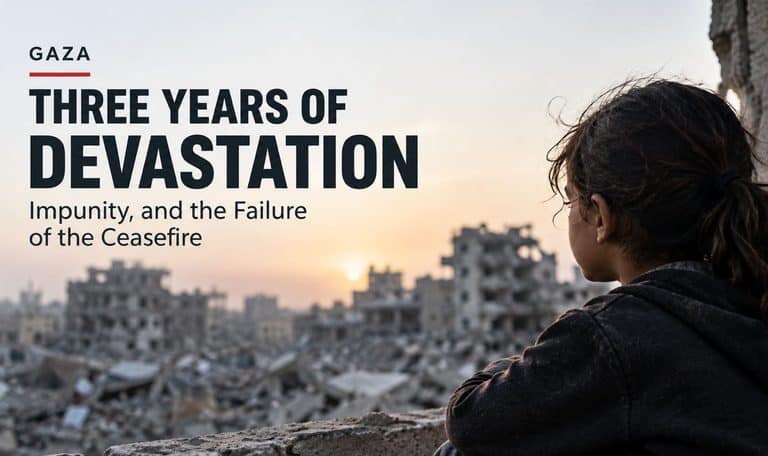
Three years of Israel’s brutal retaliatory military campaign in Gaza has taken a devastating toll. According to the Palestinian Ministry of Health, the death toll in Gaza since October 2023 has risen to 74,228 persons, and over 175,000 persons have been injured. The official death toll does not consider those who are missing: according to various estimates anywhere from 8,000 to 12,000 people are believed to be buried under the tons of debris and rubble left by Israel’s relentless bombings.
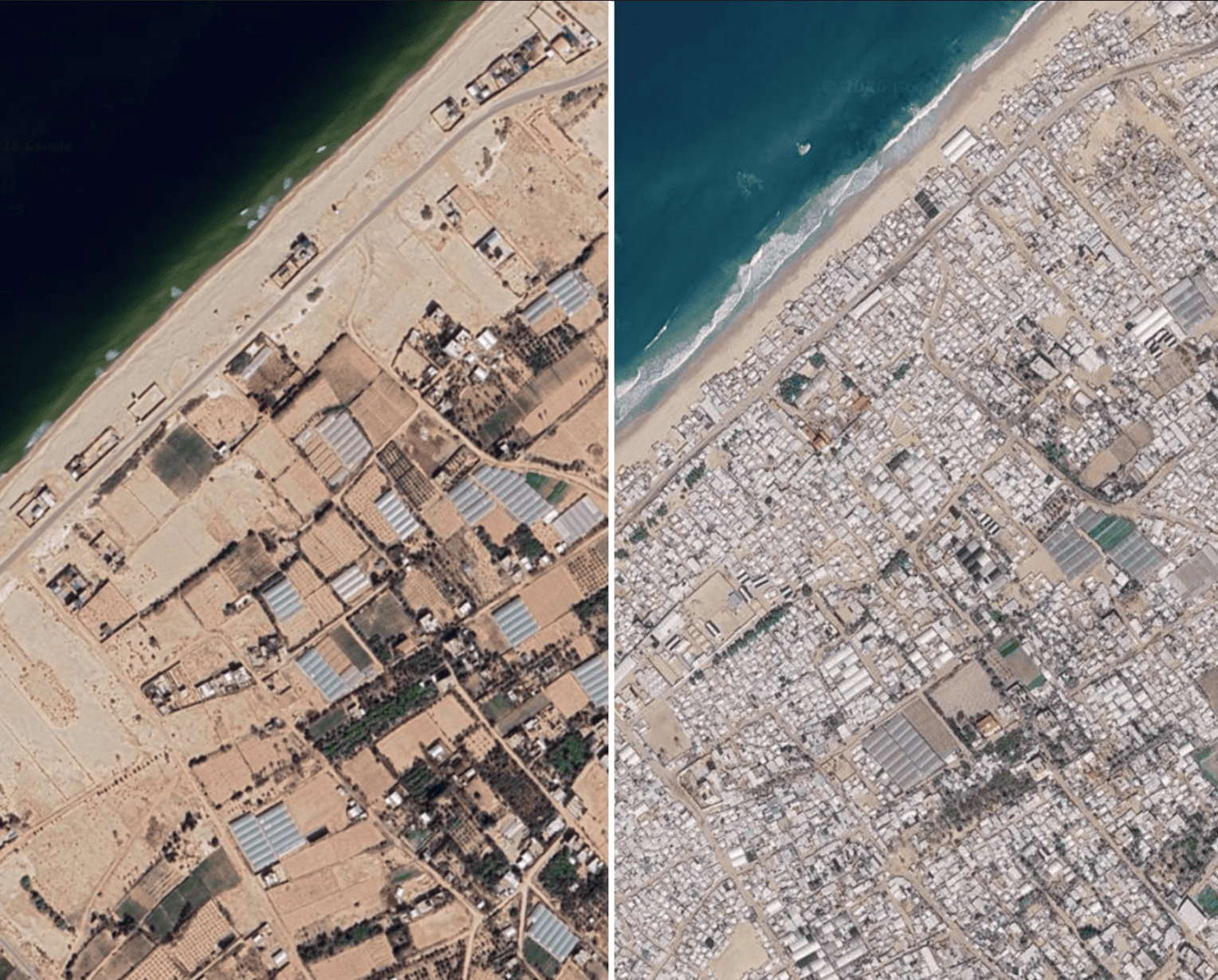
Three years after October 7, 2023, approximately 90% of the population of the Gaza Strip is displaced, the vast majority having endured multiple forced relocations, some as many as time times due to Israel’s ongoing military strikes and shifting evacuation orders. It is estimated that more than 60% of the Gaza Strip’s population have lost their homes entirely. Israeli strikes have destroyed nearly all of Gaza’s infrastructure, including homes, schools, universities, road networks, commercial buildings and agricultural land.
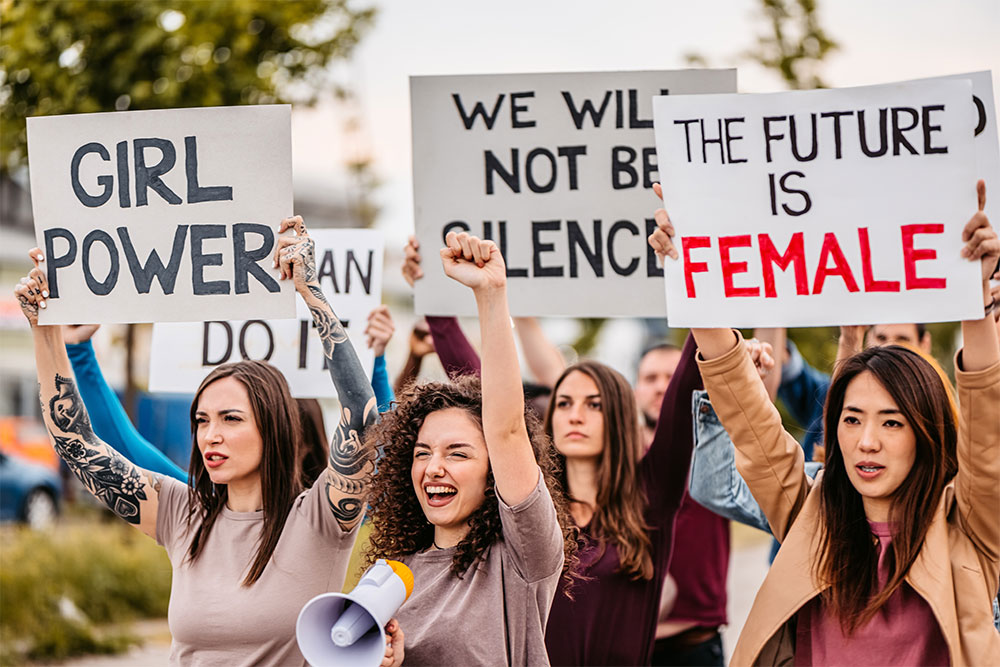
The devastation in Gaza has impacted Palestinian women in multiple ways. Women have constituted a significant percentage of those killed and injured. They have also had to contend with multiple displacements, a collapsed healthcare system, the destruction of their children’s schools, feeding their families in the midst of an engineered famine, and countless other forms of harm.
These hardships continue three years on, even as news headlines – especially after the so-called ceasefire – have shifted to other global crises and wars.
A “Ceasefire” in name only
On October 10, 2025, a ceasefire between Israel and Hamas took effect. The agreement entailed a multi-phase deal involving troops withdrawals, humanitarian aid, and prisoner exchanges, and was meant to bring an end to the hostilities.
Nearly a year since the agreement, Palestinians continue to suffer from ongoing violence, restrictions on humanitarian aid, and harsh living conditions. Aside from the initial prisoner exchange between the two sides, subsequent phases of the ceasefire agreement have not been implemented.
Not only has Israel not withdrawn from the Gaza Strip, but it now also occupies nearly 70% of the territory, having expanded its control increasingly since the ceasefire agreement. A yellow line demarcating the territory’s division gave the Israeli military control over 53% of the territory, while Palestinians were squeezed into the remaining 47% of the land. Since then, Israel has pushed further inwards, taking over more land, and has killed dozens of Palestinians (the figures are disputed) for being near the demarcation line. In the area it occupies, the Israeli military has demolished all structures, and is reported to be clearing, compacting, and removing rubble – essentially erasing evidence of its war crimes. The United Nations and numerous human rights NGOs have warned that continued expansion of areas under Israel’s control intensifies risks to civilians and further constrains humanitarian efforts.
Although Israel’s military strikes on Gaza have lessened in intensity since the ceasefire agreement, they have not stopped. Israeli forces have killed more than 1,400 Palestinians and injured over 5,000 people since the “ceasefire,” according to the Palestinian Ministry of Health.
Although the ceasefire agreement led to a temporary increase in the volume of commercial goods and humanitarian aid entering Gaza, the amount is still below what was stipulated and what is needed to meet the population’s urgent needs. Israel has continued to limit humanitarian aid and maintains an arbitrary, opaque and politicized system for humanitarian access in Gaza. For example, following the U.S-Israeli war on Iran at the end of February 2026, Israel re-closed Gaza’s border crossings for a period.
Bare survival under dire conditions
Three years since October 7, 2023, living conditions for Palestinians in the Gaza Strip remain dire. The Gaza Strip has long been described as an “open-air prison,” to the strict land, air, and sea blockade imposed upon it. Today, as a result of Israel’s reoccupation of the majority of the land, Palestinians in the Gaza Strip are squeezed into an even smaller sliver of the territory, with most living in severely overcrowded makeshift tent camps, facing environmental and health hazards, and a critical shortage of clean water, medical care, and adequate food.
Israel’s destruction of most residential buildings in the Gaza Strip has left Palestinians homeless. Their prevention of the entry of construction materials is impeding any reconstruction efforts. Some families have taken shelter in the buildings that remain, with tragic consequences. Recently, a building housing 100 displaced families collapsed, killing twenty-one people. The building had been previously hit by Israeli strikes, leaving its structure weakened and at risk of collapse.
Though constrained by lack of adequate equipment, Palestinians have also been searching through the rubble of destroyed buildings to search for the remains of loved ones they have lost and have held mass funerals for those whose bodies they have recovered.
Otherwise, daily life for Palestinians is a struggle to survive, as they contend with hyperinflation and scarcity, and continued restrictions on aid. According to aid groups, Palestinians in Gaza are still in pressing need of basic necessities including food, medicine, and shelter.
A heavy toll on women
As with all cases of warfare and intensification of militarism, Palestinian women have faced the impact of this humanitarian crisis at unprecedented scale and magnitude. First and foremost, due to the intensified bombardment, especially during the early months of Israel’s military siege on Gaza, the deaths of women and girls reached levels unseen in previous wars on Gaza. UN Women has estimated that between October 2023 and December 2025, more than 38,000 women and girls were killed in Gaza, representing an average of at least 47 women and girls killed per day. Tens of thousands of women and girls are living with debilitating injuries.
The repeated cycles of displacement have also affected women and pose particular challenges for widows and other female-headed households, who now bear the responsibility of ensuring their family’s safety through multiple evacuation orders. Pregnant women, elderly women and women with disabilities are also particularly vulnerable to harm.
Israel’s systematic attacks on health facilities and hospitals in Gaza, including maternity wards, resulted in the collapse of reproductive health services, affecting tens and thousands of pregnant women. The destruction of hospitals and shortages of medical supplies have left pregnant women without adequate prenatal and obstetric care, many being forced to give birth in unsafe, unsanitary conditions without medical assistance. High rates of malnutrition among women have resulted in increased miscarriages and children being born with dangerously low birth weights. A severe shortage of clean water and sanitary products have compromised menstrual hygiene, leading to rising rates of skin and infection-related illnesses.
Women in Gaza have experienced extreme levels of grief and anxiety, as they cope with the loss of family members, or bear witness to the pain their children suffer, for instance as they undergo amputations without anesthetics, or as they struggle to feed their hungry children in the midst of insecurity and scarcity. Indeed, it is almost difficult to conceive of the depth of trauma that women in Gaza have had to bear for the past three years.
Unfortunately, the so-called “ceasefire,” has not necessarily reduced the hardships women in Gaza have suffered. In fact, the overcrowded, unsanitary conditions under which they now live only increases their vulnerability to harm and violence. A recent report by the UNFPA documents a rise in gender-based violence in Gaza in the first six months of 2026, noting in particular an increase in early marriage as families struggle to survive amid hunger, poverty, lack of income, and school closures.
A crisis of impunity
Alarmingly, despite the nearly countless reports from UN agencies, domestic and international NGOs, and accounts by Palestinians themselves of the atrocities Israel has been committing, Israel has faced no accountability for its actions.
Within the first few weeks of its military offensive, legal scholars and historians of genocide began expressing alarm about the grossly disproportionate harm Israel was inflicting on Palestinians, calling Israel’s war on Gaza a “genocide.” At the end of December 2023, South Africa instituted proceedings against Israel at the International Court of Justice, alleging that Israel’s military conduct in Gaza violates the 1948 Genocide Convention. On January 26, 2024, the ICJ issued its first provisional measures, finding that the claims made by South Africa were “plausible,” and ordered Israel to take all measures within its power to prevent acts of genocide and enable the immediate provision of basic services and humanitarian aid. Unfortunately, Israel has not complied with these orders but has continued its offensives unabated. In August 2026, South Africa submitted evidence of Israel’s noncompliance to the court. The legal proceedings are expected to take several years to complete.
The Israeli state, which goes to great lengths to portray its army as “moral,” and claims to take measures to minimize harm to civilians, claims to be investigating some of its more egregious violations of humanitarian law, including the killing of 5-year-old Hind Rajab on 29 January, 2024, the March 2025 killing of fifteen Palestinian paramedics whose bodies were discovered in a mass grave with crushed vehicles, and the double-tap strike on Nasser Hospital in Khan Younis on August 25, 2025, which killed twenty-two people including five journalists. These investigations are ongoing, but there is very little reason to believe that there will be any accountability for these crimes.
On November 24, the International Criminal Court issued an arrest warrant for Israeli Prime Minister Benjamin Netanyahu (along with former Defense Minister Yoav Gallant), charging him with war crimes including starvation as a method of warfare, and crimes against humanity including murder, persecution, and inhumane acts. Despite this, the Israeli Prime Minister has traveled freely to the United States and spoken before the United Nations General Assembly, and the state of Israel continues to receive military assistance from the United States and other countries in the European Union.
Israel has banned the entry of foreign press into Gaza, despite their requests to be admitted. It is Palestinian journalists who have primarily been documenting and chronicling the events of the past three years, despite the immense risks they face, as evidenced by the shockingly high number of them who have been killed. According to the Committee to Project Journalists, at least 189 Palestinian journalists have been killed in Gaza. CPJ has stated that Israel has killed more journalists and media workers than any other government since it began collecting data in 1992.
It is clear that Israel targets journalists intentionally, and yet despite this, Palestinians have continued to report on these events, even as Israel has not faced any consequences.
Unfortunately, failing to hold the Israeli state to account for war crimes in Gaza has only emboldened it to expand the scope of its military offensives to other places. There has been an escalation of violence, arrests and raids in the West Bank. Israel’s military campaign in Lebanon over the past three years, which they assert to be in response to Hezbollah’s actions, have now resulted in Israel’s occupation of southern Lebanon, the destruction of multiple towns and villages in the south, and the displacement of hundreds of thousands of Lebanese. The Israeli government has also taken additional territory in Syria. On February 28, 2026, Israel and the U.S. led coordinated military strikes on Iran.
Recommendations
As Femena has continually stated in all its brief and statements regarding the situation in the Occupied Palestinian Territories, the ongoing violations will only lead to more violence, unless the root causes are addressed and rectified. A peaceful future for Palestinians and Israelis can only occur if the injustices that Palestinians have suffered due to decades of military occupation are brought to an end. Therefore:
- All parties should commit to the terms of the ceasefire, and there must exist clear enforcement mechanisms and third-party monitoring to ensure accountability.
- An impartial, international monitoring presence should be introduced to document incidents of violation and provide clear and transparent reporting.
- All parties must take measures to respect the safety and protection of civilian populations and strictly adhere to principles of international humanitarian law.
- Allegations of human rights violations should be investigated by independent bodies and those responsible – regardless of affiliation – must be held accountable through credible legal processes.
- Women’s organizations and women human rights defenders should be supported in order to document and address the violence experienced by Palestinian women, especially sexual violence resulting from conflict and displacement.
- Israel must ensure that humanitarian aid, especially medical supplies, foods and other essential material desperately needed by Palestinians in Gaza reaches them.
- Aid organizations and donors should specifically address the needs of the most vulnerable and marginalized populations – widows, orphans, the disabled, the elderly, children – through special programs, including financial support.
- As per international law, Israel’s occupation of Palestinian Territories is illegal. The Israeli military must withdraw from the territories it has reoccupied in the Gaza Strip as well as all territories it occupied.
- There should be renewed diplomatic efforts by international and regional actors to find a political solution that is just and sustainable, and one that involves the participation of Palestinians.