

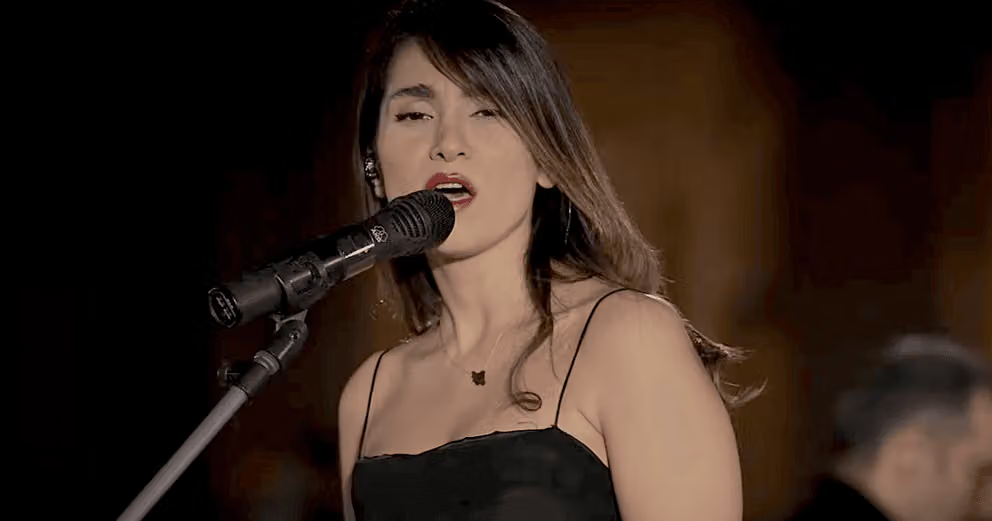
On the eve of November 25, the International Day for the Elimination of Violence Against Women, Iranian singer Parastoo Ahmadi was subjected to 74 lashes today for performing a concert, enduring one of the most severe forms of state-sanctioned and judicial violence against women. Her punishment comes nearly two years after she performed at the historic Deir-e Gachin Caravanserai, openly challenging the Islamic Republic’s decades-long ban on women singing solo in public.
According to her lawyer, Mostafa Nili, the flogging sentences against Ahmadi and four members of her concert production team; Soheil Faghih-Nasiri, Amin Taheri, Amirali Pirnia, and Mohsen Lashkari, were carried out today, November 23, at the sentence enforcement office of the Qom Prosecutor’s Office.
The case stems from Ahmadi’s performance at the historic Deir-e Gachin Caravanserai in Qom Province, which was published on her YouTube channel on December 11, 2024. The performance, widely known as the “Imaginary Concert,” featured Ahmadi singing without compulsory hijab, accompanied by male musicians. The video attracted millions of views and widespread public support, becoming a powerful symbol of women’s resistance against discriminatory restrictions on artistic expression.
Following the performance, judicial authorities prosecuted Ahmadi and members of her production team. Branch 122 of the Qom Criminal Court sentenced each of them to 74 lashes, a two-year ban on artistic and musical activities, and a two-year travel ban on charges of “offending public decency through producing and distributing obscene and immoral content online.” The sentences were subsequently upheld by Branch 16 of the Qom Court of Appeals.
More Than Four Decades of Silencing Women’s Voices
Since the 1979 Islamic Revolution, women in Iran have been prohibited from performing solo concerts before mixed-gender audiences. For more than four decades, female singers have been denied the same opportunities as men to perform publicly, pursue professional musical careers, and freely express themselves through their art. Women have largely been restricted to performing for women-only audiences or singing alongside male vocalists.
In recent years, particularly following the Woman, Life, Freedom movement, a new generation of young Iranian female singers has increasingly challenged these discriminatory restrictions. Through street performances, online concerts, and videos shared on social media, they have sought to reclaim their voices and their right to participate equally in Iran’s cultural and artistic life.
Their resistance has come at a significant cost. Female singers, including Zara Esmaeili and Hiva Seyfizadeh, have faced arrest, detention, prosecution, and severe prison sentences for exercising their right to sing. Seyfizadeh was sentenced to four years in prison following her arrest during a live performance in Tehran in February 2025.
The flogging of Parastoo Ahmadi is not merely punishment for a musical performance. It is an act of state-sanctioned violence intended to punish and intimidate women who refuse to accept discriminatory restrictions on their fundamental rights. The timing of this punishment, just two days before the International Day for the Elimination of Violence Against Women, is a stark reminder that women in Iran face not only violence within their homes and communities but also violence institutionalized and carried out through the judicial system.
Judicial flogging constitutes cruel, inhuman, and degrading punishment and violates the absolute prohibition of torture and other ill-treatment under international human rights law.
Femena strongly condemns the flogging of Parastoo Ahmadi and the four members of her production team. As the world begins the 16 Days of Activism Against Gender-Based Violence, Femena calls on the international community and UN human rights mechanisms to recognize and address the role of discriminatory laws and judicial punishments in perpetuating violence against women in Iran.