

According to Iran’s Ministry of Health, the U.S.-Israeli military strikes on Iran have so far resulted in more than 2,076 deaths and 26,500 injuries, including thousands of women and children. Meanwhile, a segment of the Iranian opposition, supportive of military intervention as a means of “saving” the country now seeks, in the face of widespread civilian casualties, to downplay or deny the reality by invoking claims of “precision targeting,” framing the human toll as mere “collateral damage.”
In this climate, any reference to the targeting of infrastructure or civilian areas is constantly met with accusations of “supporting the Islamic Republic.” Such accusations have escalated to the point where even photographic evidence, depicting destroyed homes and the shocked, grief-stricken faces of affected civilians is dismissed as fabricated.
On March 28, Iranian photographer Mehdi Ghasemi published a series of harrowing and deeply moving images from a residential neighborhood in Abbas Abad, Tehran, images that clearly documented the devastation caused by U.S.-Israeli missile strikes. Beyond the ruins of shattered homes, the photographs captured injured, stunned civilians covered in dust, struggling to comprehend and survive the aftermath.
Almost immediately, a coordinated online campaign emerged, claiming that the individuals in these images were “actors” allegedly employed by the Islamic Republic for propaganda purposes, and that the scenes bore no relation to reality. Disturbingly, some official media outlets amplified these unfounded claims, effectively denying the suffering inflicted upon innocent civilians and attributing it to state fabrication.
In response, acquaintances of those depicted in the images took to social media to challenge this narrative. They affirmed that they personally knew these individuals, that they had no affiliation with the Islamic Republic, and that their homes had indeed been destroyed, leaving them to endure profound and devastating hardship. The internet shutdown, information control, and the restrictions and bans imposed by the Islamic Republic on the activities of independent journalists have further exacerbated this situation.
The combination of these conditions has resulted in the names and images of civilian victims rarely being made public. Nevertheless, some feminist journalists and women’s rights advocates, despite security threats and internet blackouts, continue to work tirelessly to ensure these individuals, and the lives and aspirations lost with them are not overlooked and forgotten.
Through writing and storytelling, they resist the dehumanization of the innocent victims and those harmed by this war. The Children of Minab, a report written by Elnaz Mohammadi and published in Shargh newspaper, whose English translation was later published in Femena, stands as an example of these feminist efforts to make visible the suffering of innocent civilians in Iran.
The following report, originally published by Khabaronine, was written by Negin Bagheri, a journalist and women’s rights advocate who also faced judicial prosecution for her activism during the Mahsa Amini protests.
In this report, she writes about the attack on the volleyball court where young girls were practicing in Lamerd, an incident that took place on the first day of the U.S. and Israeli airstrikes on Iran and claimed the lives of several civilian citizens. According to a report by The New York Times, on the first day of the war, the United States used a new ballistic missile known as the Precision Strike Missile (PrSM), a short-range ballistic missile designed to replace Army Tactical Missile System (ATACMS), which had not previously been tested in combat. The missile is a short-range system designed to detonate above its target, dispersing fragments through the air.
Online campaigns advocating military intervention made extensive efforts to attribute these missiles to the Islamic Republic and to silence discussion of the victims in Minab and Lamerd, who were predominantly children. It is precisely in such a context that reports like this acquire even greater significance. As a human rights organization, we have translated and are publishing this article in an effort to document and bear witness to the destruction and suffering this war has inflicted, particularly on innocent civilians. Our aim is to amplify the voices and perspectives of rights defenders within the country, as well as those most directly affected by this horrific crisis, who continue to endure the devastating consequences of attacks on civilians and ongoing violations of humanitarian norms. We will continue to publish and document similar voices and perspectives emerging from Iran.
A Story of the Attack on the Lamerd’s Volleyball Court of Girls: How Helma and Elham Lost Their Lives on the First Day of the U.S. and Israeli Airstrikes
By Negin Baghri- originally published in Khabaronline
On the evening of Saturday, 28 February, Elham, Helma, and the girls on the junior volleyball team were practicing in the sports hall, taking their positions and striking the ball with strength to defend against it, not against the missile that, only minutes earlier, had been launched toward their net.
With just twenty minutes remaining of the class, at 5:10 p.m., the girls had gathered in a circle around their coach in the middle of the hall to learn a new drill when the first rocket struck a military base nearby. The second exploded directly in the sky above the heads of the 26 girls, and the third hit the city’s ring road approximately 200 meters in front of the sports hall.
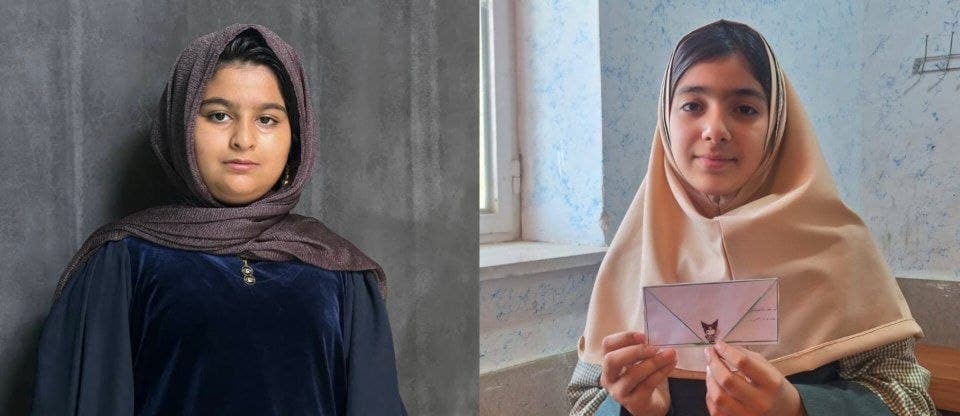
From those white streaks across the sky and the storm-like roar of the missiles fired toward their city of 44,000 residents, 21 people were killed. Two of those 21 were Helma and Elham, the same two girls who, since 28 February, had been reduced in public discourse to a single phrase: the two volleyball girls of Lamerd. Helma Sadat Ahmadizadeh, a fourth-grade student, was just ten days away from blowing out the candles on her birthday cake. Elham Zaeri, a fifth-grade student, was due to celebrate her birthday one month later.
Another member of Helma’s family has also been drawn into the war. She is the cousin of Zahra Ahmadizadeh and a member of Iran’s women’s national football team, who, after a controversial trip to Australia, is now stranded in Malaysia with the team, waiting for the borders to reopen.
Escaping a 50-Meter Hall in 10 Seconds**
The coach of Lamerd’s volleyball school recounts that day step by step:
At the sound of the first explosion, the hall’s electricity was cut off. Wherever they were standing, everyone tried, in the dim twilight that had already given way to darkness, to feel their way toward the exit.
The coach kept shouting, “Everyone out. Get outside.”
But the second missile allowed no time for evacuation. How could anyone reach the exit door of a hall 50 meters long in just ten seconds? As the children were running, the second rocket exploded mid-flight, directly above the club. Its shrapnel tore through the roof from just five meters above the ground and struck the young volleyball players of Lamerd in Fars Province. From outside, flames were rising from the hall, while smoke filled the eyes of the girls, students from second to fifth grade.
Elham’s brother arrived before the ambulance. He found her among the girls and lifted her into the car; her hands and feet covered in blood. The doctors later said that her precious life had already ended there, before she ever reached the hospital. Elham’s father says his daughter had many dreams of becoming a volleyball player. Taller than most children her age, she was able to return the services of her older brothers, leaving them astonished.
Helma was able to walk to the ambulance on her own. There was not a single trace of blood visible on her body. She had fled the hall with the others and said only one thing to her coach: “I feel like something has gone into my body.” When she lifted her shirt, it looked like nothing more than a small, blade-like fragment, hardly a wound that seemed fatal at first glance. The girls who, only moments earlier, had been breathless from an intense training session were now gasping for breath in the hospital, overcome with fear.
That same night, 10 to 12 of them underwent surgery at Lamerd Hospital. One little girl had lost a finger, and three others were rushed to Shiraz in critical condition. The coach had been struck by shrapnel in the head and the back of the hand, while the assistant coach had suffered deep tears to the skin around her throat and the side of her neck. Yet among all of them, Helma appeared to be the one farthest from death. According to her uncle, that same small black fragment had pierced her heart. At around 7:00 p.m., despite the nurses’ efforts to revive her with CPR, she could not be brought back to life.
What Happened to the Others: Three Workers, Several Students, Housewives, a doctor, and an Employee
It wasn’t just these two young athletes. Ilya Khatami, a sixth-grade boy, and his coach, Farhad Najafi, who were playing on the football club’s adjacent field, also lost their lives to the same shrapnel. The third missile, which struck the ring road area of Lamerd, claimed the lives of three workers, two of whom were on the job at the time: one a local resident, another from Mamasani, and the third from Afghanistan.
A housewife, who according to southern customs had been sitting at her doorstep with a hookah at that very moment, is now listed among the martyrs of Lamerd. A grocery store vendor, a pedestrian residing in Norway who had been shopping at a pharmacy, the deputy of Lamerd’s special customs zone, and several students also lost their lives in the blast.
The MRI department manager of Lamerd Hospital had just returned home from work when the explosion occurred. Upon hearing the sound, she threw herself over her daughter. The girl survived but the mother did not. The brother of one of the victims is another student, now paralyzed, who has still not learned of his sister’s death. Another student was blinded as a result of the same explosion. Other residents describe the black fragments from the blast as blade-like, piercing the body in ways that, though invisible from the outside, shattered bones just as they did with Helma.
The Missile That Turned Lamerd into Mourning After Minab
Although these days the Trump administration has been compelled at every press briefing to answer questions about the deliberate targeting of Minab School, the attack on Lamerd also raises ambiguities from two angles: the second missile struck the western edge of the club, and the third hit the Lamerd ring road about 200 meters west, claiming the lives of numerous innocent civilians.
From the points of impact of the second and third missiles, it is evident that these weapons did not target military sites but instead struck two densely populated civilian areas. Among those affected was the junior volleyball team, ten of whom had been set to enter the court for provincial competitions once the exam season ended. They had hoped to spend the spring practicing, to prepare in the summer for the competitions, to cheer each other loudly, to stand on the podium at the end of the festival, and, raising the cup above their heads, to dream of competing on the world stage.