

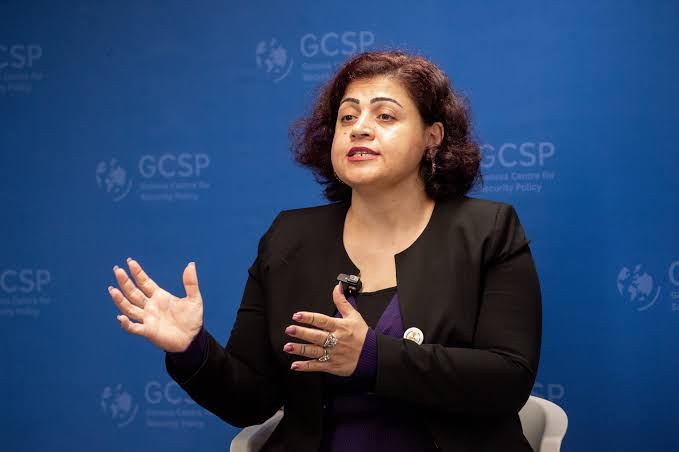
Lubna Alkanawati is a Syrian feminist, human rights defender, and the executive Director of Women Now for Development, a prominent civil society organization dedicated to empowering women and girls in Syria and the broader region. Based in France, she has been a pivotal figure in advocating for women’s rights and gender justice amidst the Syrian conflict. Alkanawati’s activism began during the early stages of the Syrian Revolution in 2011. She participated in peaceful demonstrations and later focused on humanitarian aid in besieged areas. Alkanawati’s work has garnered recognition for its impact on women’s rights and humanitarian efforts. Her leadership continues to inspire and drive efforts toward gender justice and peace in the region. We sat down with her and asked about her experiences in activism in turbulent Syria. In the following interview, we asked about her experiences during Syria’s turbulent years. She talks about the beginning of her work, at a time when she did not yet identify as a feminist and had very limited resources, up to the present, when the organization under her leadership has expanded to different cities across Syria, is registered in five countries, and provides a wide range of services to Syrian women.
Thank you very much, Lubna, for taking the time to speak with us today. To begin, could you please introduce yourself and tell us a bit about your background, your journey, and the work that has brought you to where you are today?
My name is Lubna Alkanawati. I am a Syrian feminist and human rights defender. I am currently based in Lyon, and I serve as the Executive Director of an organization called Women Now for Development. I have experienced many horrific things, but I also define myself as a survivor of chemical attacks, siege, forced displacement, and sexual violence. I choose to identify with the violations I’ve endured, because they are a part of who I am now.
Thank you for being willing to share your experiences. I understand that these topics can be difficult to talk about, and I don’t want to put any pressure on you. But we would really appreciate hearing your story. To begin with, I’d like to ask about your personal experiences during the revolution. I’ve read the piece about the chemical attacks, but I’d love to hear directly from you. Then, I’d like to move on to the broader conflict in Syria and hear about how you and your organization responded, what kinds of strategies, interventions, or activities you implemented during the conflict, particularly in support of women. Lastly, I’m very interested in hearing your perspective on how the war has affected women in Syria.
It’s a big question and it has many layers, because we are talking about a long-term armed conflict. We have experienced many levels of violence and many ups and downs, also in terms of interventions and the ways we have dealt with problems in the community, which were different from one period to another, including my own experience and the experience of the organization.
Women Now started its work in response to the needs that emerged in the community in 2012 after the revolution, and I joined the organization early in 2013. At that time, when I was in the Damascus suburbs, we had very limited resources and there was only a narrow understanding of civil society. I did not have many tools. So, what we did could not really be considered an intervention; it was more about trying to make a difference in women’s lives together, and to make everything around us a little better, because we were living in a very awful situation.
Of course, later, when you gain more experience and get access to more tools, you find yourself trying to reach deeper stages, to deal with the community in a more organic way. But also, the knowledge, tools, and experiences we gained -specifically from the international community and from other actors in other contexts- were sometimes complicated.
At Women Now, we first started by opening safe spaces for women and girls. We didn’t call them that at the time. We didn’t even call the organization Women Now then, we called it a women’s centre. It was simply a space where women could gather, talk together, and learn some skills, mainly vocational training. This became our essential activity. Then we started to develop and evolve. Today, we have a wide program across Syria, we are registered in five countries, and we are the most impactful women’s organization in Syria. I mean, we have had a positive impact on women’s lives.
What I want to say is that collective awareness also grew with us. We didn’t start as we are now. What keeps shaping this awareness, vision, and mission of our work is the experience of women and girls on the ground. This also affected me personally, because I remember that I didn’t know what feminism or being a feminist meant. I didn’t even identify myself as a women’s rights defender or a human rights defender. When I chose to be a feminist and a human rights defender, it was a conscious choice. I had experienced inequalities directly in my own life, and I witnessed them in other women’s lives. This is how my pathway was drawn toward becoming involved in this work.
Now, our programs in Women Now have grown a lot. In one of our projects, we work on women’s leadership and participation, which of course includes supporting women human rights defenders and women-led initiatives. We support them with financial aid, technical support, and psychosocial support. We also work on protection: we provide social support, we do case management, and we work on countering gender-based violence and sexual and gender-based violence.
Our third program focuses on feminism, justice, and accountability. In this area, we also do a lot of knowledge production. The article you read is one example of how we try to amplify women’s voices about the major crimes that happened in Syria. We recently published a research report called The Ongoing Crime. It is also about the chemical attack -the same attack- but it provides a very deep gender analysis of it.
What we are trying to do is to create the right conditions for women’s meaningful participation: to give them greater access to justice, to resources and opportunities, and to enable them to influence decision-making and positions of power. So, yes, I hope I answered your question
Can I take you back to when you first started your work? Obviously, now your organization has expanded a lot, but at that time it wasn’t like this. You mentioned safe spaces for women, what kind of services did you provide for them back then, after the revolution and when the conflict began?
The revolution started in 2011, and I guess the peaceful phase of the revolution ended in 2012. At that time, there were also what we called liberated areas, meaning areas outside of Assad’s regime control. These areas were controlled by armed groups, and usually civil society organizations could only work in those areas. Because otherwise, in regime-controlled areas, everything was completely controlled by the Assad regime and affiliated structures.
So, Women Now started its activities by giving micro-grants to local initiatives. After this, the founder of the organization decided to take it further and, together with a group of women, established Women Now.
We opened several community centers, safe spaces for women and girls. We opened our own center at the end of 2013, beginning of 2014. The community centers at that time focused mainly on vocational training. We provided several kinds of vocational training, but also educational activities like language classes -Arabic and English- computer skills, awareness sessions, and things like that. They were very basic activities at the beginning.
By the next year, in 2014–2015, we started to develop more. We began to focus on women’s leadership, because we realized there was a strong need to build women’s capacity so they could hold decision-making positions. So, we started our leadership program, and this was combined with economic empowerment. We have this holistic approach, because you cannot do political empowerment if women are hungry, or if their families are hungry. If you want to target a specific area, you have to make sure other areas are also covered.
From this point, we also began to develop other programs. For example, we added psychosocial support, because we witnessed the huge burden placed on women due to the shifting of gender roles caused by the conflict. We lost many men in the war, they were killed, detained, or went missing. So, women had to take on new roles. This shift in gender roles also forced women to gain new skills, so they could adapt to everything that was happening.
So, this is how we started. And of course, when I talk about where we are now, it has taken us more than a decade to build this step by step, responding to the needs. After we began thinking about the political aspect and how we needed to be involved, this also came as a reaction to the control of armed groups. Because we realized that in all the parties we were dealing with, civilians were absent from the scene, and not only civilians, but women were totally absent. Even when there was a local council trying to do something, or a director, for example, a director of education, of health, or municipalities. There were no women involved. And if there were women, it was a very tiny percentage, included only because donors asked for it. Those women, too, faced a lot of challenges. This is how we built our leadership program: to support women’s participation in political spaces and in the public sphere. So, every program we developed came as a response to the needs of women in the community.
You mentioned earlier that when you first started your work there was very limited understanding of civil society. what did the landscape look like in terms of feminist groups or women’s rights organizations operating on the ground? Were there already many such initiatives active at the time, or was the space still very limited? And how did the broader context of the revolution and the early years of the conflict shape the presence -or absence- of feminist and women-led organizations?
there wasn’t really such an environment. I mean, even now it’s very difficult to identify every group as a feminist group. There are some groups that define themselves as feminist groups, but most of them just see themselves as women’s groups.
Because “feminist” as a word is misunderstood and demonized in the Syrian context. Yeah. Because we have also been under the control of so many extremist Islamic groups. These groups criminalized anything related to gender, empowerment, feminism, secularity, all these terms were forbidden to use in the community. They demonize them. It is considered haram. You couldn’t talk about it. It is seen as something that would ruin the family. So, we couldn’t use this term. That’s why women’s groups usually avoided it. They would say, “we are a women’s group working on women’s issues.” And even if they wanted to work on women’s issues, they would avoid saying that they worked on women’s rights. Because even “women’s rights” is considered very risky for an organization. You know, almost all men in the community understood “women’s rights” as meaning you want to get women divorced from their husbands, you want to do haram things. That’s what they thought.
So, instead, groups usually say they work on protection or economic empowerment. They use language that is acceptable to the community. And I think this is a good thing in a way, because they find their own way to intervene in the community. But the problem is that the risk for them is always very high. They are always under threat, because no one thinks their work is valuable or necessary.
At that time, though, there were a lot of women leaders, because many of them came from an activist background in the revolution. Just like myself, I didn’t start as a women’s rights activist. I started because I was involved in the revolution as an activist. But then, step by step, over time, I began to work in civil society, and I chose to work with women. A lot of my comrades in the Syrian context did the same. Most of them started like this.
So, those gatherings in the beginning were not very clearly defined as women’s groups or feminist groups. But I guess it became clearer in the Syrian context starting from 2015. Between 2015 and 2016, Syrian women started to organize more, and these kinds of groups began to identify themselves more explicitly as women’s groups. It was no longer just a woman activist leading something, they were groups, moving together, with collective issues and missions.
earlier, you mentioned international support and noted that it can sometimes be more challenging than beneficial. Could you elaborate on that?”
When we talk about gender, now, I think the way the international community approaches gender in conservative contexts like ours, maybe in Iran, Afghanistan, or the Arab region, is often very wrong and misguided. They rarely consult the community or the women themselves on how to approach these issues. For the community, these concepts can feel very foreign or even strange.
I remember many international non-governmental organizations came to us with programs they had already implemented in places like Ghana, Afghanistan, or other conflict zones, and they expected us to implement the same programs in Syria without considering the local context or sensitivities. These kinds of interventions can cause significant harm. I think a lot of the reactions we see from the community are a result of this kind of externally imposed funding. Organizations are often forced to implement these programs because there’s no other way to secure financial support, and funding is necessary to survive and carry out any activities.
This put us under huge risk. Later, we were often told, “Okay, now you need to find your own way,” which forced us to re-evaluate everything we were doing and move away from these externally designed approaches. Most of the time, this kind of intervention disconnected us from our roots. What we are trying to do now is re-root ourselves, reconnect with the community, and understand how women in the community usually solve their problems.
For example, we are now working on a large project with the UN Trust Fund addressing domestic violence. Domestic violence is one of the major problems in our community. It is often normalized, people accept that a husband, father, or brother has the “right” to beat a woman. They even sometimes justify it by citing the Quran. So, the situation is extremely delicate and critical.
If we want to address this, we cannot simply open shelters, women will not come. We have tried that before. Women do not report their husbands because there is a long list of red lines they cannot cross. They are not independent, there is no law protecting them, they have nowhere to go, they will be stigmatized, and their honor could be questioned. In some cases, they could even face honor killings.
Given these challenges, we decided to adopt an approach that we call community organizing. This approach is based on the experiences of women themselves, who have been victims of domestic violence, working together to find solutions within their own community. By organizing among themselves, women can achieve significant results. We tried this approach before, for example on early marriage in Lebanon, and the outcomes were substantial. You can find the report “Let Me Keep My Childhood” on our website. What I want to emphasize is that solutions are not always written in reports, books, or formal guidelines. Sometimes, you need to engage local community figures, like elders or mediators, who can influence men and convince them to change. These community-driven solutions are often more effective than building shelters that no one uses. What we are trying to do now is act as a filter, observer, or controller regarding the harm or mistakes the international community has caused in our communities, locations, and lives, because there has been a lot.
Could you describe the relationship between feminists within Syria and those in the diaspora? Considering that you are currently part of the diaspora, how would you assess this relationship based on your experience working inside Syria? Was it characterized more by collaboration, conflict, or mutual support?
It existed, but after the fall of the Assad regime, the power dynamics changed. Before that, diaspora activists and organizations had significant influence, they had connections, relationships, and the ability to affect decision-making. After the fall of the Assad regime, however, most of the power shifted to actors inside Syria.
Do you mean they had influence within the Assad establishment?
No, outside the regime. Let me clarify, before December 8, 2014, Syria was divided into three main areas. One was under Turkish control and Hay’at Tahrir al-Sham. The second was under Kurdish control, and the third was under Assad regime control. When Hay’at Tahrir al-Sham took over Damascus and Assad fled, most of the country, except the Kurdish areas, fell under the control of this group. They became the new governing authorities. Before this stage, we were working outside regime-controlled areas, documenting violations by both the Assad regime and armed groups. Because we had access to funding, Syrian civil society was very powerful.
After the fall of the Assad regime, however, the donor community preferred to fund projects inside Damascus. This significantly shifted the balance of power. The diaspora almost lost its influence, and the focus became entirely on anyone operating inside Syria. I think this political shift is the reason. Before this, the international community did not work directly in Damascus. Most international NGOs were not able to operate there; they had the option to work under the Assad regime or in non-regime-controlled areas. So, most of them were working outside regime-controlled areas.
Now, because Assad has fallen, all the donors want to work in Damascus, in the new areas they have access to. They have put themselves in a competitive environment with us. Before, they were not able to implement projects themselves. Now, with a state in place, they can register and operate directly. Previously, as a civil society, we had the upper hand, we were the ones implementing all their projects and our own projects in non-regime-controlled areas. Now, they can implement themselves. Syria has the entire foreign community present. They go, assess what they want to work on, and forget about us, they think they don’t need us
does the new government provide any space for women’s rights activism, or is it likely to be entirely restricted? How do you assess the prospects for women continuing their advocacy on gender-related issues under the current regime?
It’s very tricky because the new government is committing many human rights violations. let me put it this way. Under the Assad regime, there were massive violations against women, and these violations didn’t just disappear when the regime fell, they remain. Some of the violations are no longer occurring, like those involving detainees, but the effects of the violations that happened over 14 years -people who lost their homes, their husbands, and so much more- persist.
The new government came from a radical background and was also involved in many human rights violations, so women’s rights and participation are still very fragile and now women are excluded from the public sphere.
However, because the country is destroyed, they need funding, and who provides it? The EU, the United States, Canada, and Gulf countries. Those from the Western community often make it a condition that women are included in decision-making positions. As a result, some women are placed in these roles, as a diplomatic act to please the international community , in the front-facing scene. Behind the scenes, there are very few women, and those who are included are adopting the new government view as a part of it .
The situation is extremely complex, especially because of a potential sectarian civil war between Sunnis, Druze, Alawites, and Kurds versus Arabs. This makes connections between the diaspora and Syria, and within Syria itself, even more fractured. People who were once our feminist allies no longer share the same values.
For example, we were working in northern Syria, outside regime control. For 14 years, our focus was on bringing down the Assad regime. Now that the regime has fallen, we no longer share mutual goals.
This has created a huge disconnect, not only between those in the field and the diaspora, but also within the diaspora itself. Some are aligned with the new government and sectarian identities, while others are not. Syria is now completely divided. During this period, we are essentially rebuilding and reorganizing our networks. Even the feminist movement inside Syria is no longer cohesive, it is restructuring and adapting because the dynamics have changed entirely
It’s very risky to speak out. What I was trying to say is: people who used to be your allies are not anymore. Now, everyone is a potential suspect to you. You don’t know where you can speak, who you can speak to, or even what you can talk about. There are very few voices that exist outside Syria, and they don’t want to go back. They speak but they are very few. The rest are silent. We are all witnessing and trying to figure out.
I was planning to go back to Syria before what happened in Suwayda. After what’s happening now in Suwayda, in the south of Syria, I feel like I really don’t want to go anymore. I didn’t leave Syria only because of the Assad regime. I left because I was threatened by them, by those who are in power now.
After the fall of Assad, we Iranians followed the news, images, and videos moment by moment. A video was released showing Syrians returning to the country en masse. We heard that activists were also going back. I guess that is the time you were also planning to go back.
That was the first period, what we call the honeymoon period. It lasted for about two months. But after that, specifically after March 6, when the massacres in the coastal area began, everyone was shocked by what happened.
My final question is: how do you see the role of feminist self-care and collective care in sustaining activism and resistance? Based on your own experiences and reflections, how important are these practices for the longevity and resilience of our movements?
It’s vital, not just important, but truly vital because we are always on the front lines, constantly under unimaginable pressure. I believe both individual and collective care are crucial, especially since we suffer from collective trauma. Even if someone accesses individual self-care or psychosocial support, we still need collective problem-solving to address the shared trauma we carry.
This is what happened to us in Syria and I assume you’ve experienced something similar in Iran or Afghanistan. When a group experiences collective trauma, any single triggering event for one individual can reactivate the trauma for the entire group. For example, I know many people who lived under siege for a long time. I’m certain that all of them are being re-triggered now by what’s happening in Suwayda, where the new government is imposing a full siege on the entire province in the south. So, these kinds of issues can’t be resolved by working on just one level, you need to address both the individual and collective levels simultaneously.
And I still see a significant gap in this field, not just within feminism, but in the broader understanding of mental health, psychosocial support, and self-care. But we try to practice care within our work. Yes, this is one of the main things we prioritize across all our programs. We have a lot of policies, and we also have a lot of experience. In addition, we provide direct services to the community. For example, one of our largest current projects is focused on providing psychosocial support and mental health services to former detainees, those who have been recently released. This work is also connected to the toolkit we developed on the concept of ambiguous loss. ambiguous loss refers to a very specific type of loss. It’s actually a clinical term. It’s used for people who have lost someone through forced disappearance, like when someone is kidnapped or just vanishes, and you have no idea where they are.
This kind of loss follows a very different grieving process compared to what happens when someone dies, you bury them and begin to mourn. In the case of forced disappearance, the mind refuses to accept that the person is dead, even if you’ve been searching for them for 20 years. You hold on to hope. You don’t know. You can’t say goodbye.
This happens often to people who have been detained or forcibly disappeared for political reasons. I don’t know if you have similar cases in Iran -people who’ve disappeared because of the government- but in Syria, we have around 200,000 people who have been forcibly disappeared. Some were officially detained, but after that, they just vanished. We don’t know where they are. There are reports suggesting the regime killed them. But even if that’s true, where are their bodies? Where are their graves? We have no answers. Nothing. That’s why this kind of loss needs a specialized approach.
So, we developed a toolkit, it took us five years to create. This toolkit isn’t for training just anyone, it’s designed specifically to train psychosocial specialists, so they can provide tailored support to people affected by this kind of trauma. We offer services using this toolkit, and we also do case management, cash assistance, and provide support not just to survivors, but also to care providers, to their families, and to the families of the detainees.
We try to involve and support the entire community that is connected to this issue, so that they can have access to psychosocial support, well-being, and self-care. We also have a policy on self-care, but it’s not just about having a policy, we truly believe that care, like feminism, is an everyday practice. You cannot just put it in a policy; you need to make it part of the culture. Because we live in a very, very rough and brutal environment -constantly dealing with killing, risk, and pressure- you need to be merciful, patient, and caring in everything you do.
Could you reflect on your experience with transnational feminist solidarity throughout the different stages of Syria’s recent history? Specifically, how did such feminist connections and collaborations manifest during the revolution, throughout the years of war, and now in the current period of transition? In your view, how effective have these forms of transnational feminist analysis and solidarity been, and how would you evaluate their impact on local feminist movements?
It depends, because I do believe that solidarity exists, but how you feel it, and how you receive it, really matters. It also depends on who is providing it. For example, I know that Western communities try to approach us in the Global South with care, but often, that care feels more like custody. It’s as if we are seen as a second tier of feminists. They don’t really believe we are equal to them.
So even when solidarity comes from these organizations, it often feels like supervision, solidarity mixed with pity or distant care. They cannot live our situation. They don’t truly understand it. They feel sorry, and they try to help -which is appreciated- but sometimes they can’t offer real solutions.
That’s why I believe in what I would call productive solidarity: solidarity with people who have survived, or are still experiencing, the same conditions. For example, when I talk to Iranian activists, or Afghan activists, or even Iraqi activists who have lived under radical armed groups, we immediately recognize how similar our struggles are. We share the same root problems: how religion is used against us, how gender and politics intersect to oppress us.
In those conversations, we can exchange tools: how to survive, how to support each other, what strategies we use, and what examples have worked. Just the other day, I had a meeting with women from Bosnia, and it was incredibly powerful. Even there, you can see how the UN’s interventions have caused similar harm in their communities, just like in ours. And in that moment, you realize you’re not alone. It’s not just about receiving “care” in the form of funding or attention. It’s about finding people who know exactly what you’re going through.
Sometimes I try to explain things, like what it means to live under siege, or how hard it is for a woman in an Islamic society to leave her house alone, without a male guardian, and attend a meeting and immediately she’s judged by her family, called names, or accused of dishonor. Even when people from outside try to understand, they do it through their own lens. It becomes, “Oh, those poor Arab women, so oppressed.” But it’s not that simple. It’s a much more complex dynamic that you can only begin to understand by being in the community.
This is why we always advocate for supporting grassroots movements and women-led initiatives on the ground. These are the people who truly know what needs to be done, how to do it, and how to support each other. So yes, international solidarity is important. But often, it comes with conditions, or from a place of hierarchy. And it makes me feel unequal. At the end of the day, I am a woman of color. I am a Muslim Arab woman. And even though I try not to define myself this way, I constantly feel like others are defining me like this. And I’m also a refugee. That adds another layer to my struggle. So yes, it’s complicated. But I find solidarity within the Global South to be far more powerful. And we need to build and strengthen that.
Looking back over the course of your activism, what forms of intervention or practices have been transformative for you? Which of these practices have not only shaped your work but also given you a sense of purpose, continuity, or hope? In other words, what kinds of action or engagement have helped you sustain your commitment and find meaning amid the many challenges you’ve faced?
What gives us hope is sometimes different from what we find effective or impactful in practice. In my experience, one of the most active and meaningful approaches has been the survivor-centered model of intervention. It operates on multiple levels of empowerment. People feel seen, their immediate needs are addressed directly, and they are given space to express themselves freely.
When you work with survivor groups or adopt a survivor-based approach, you realize how much even small steps can mean to people. It makes you feel that your efforts, no matter how limited, are bringing real justice, or at least a sense of it, to those most affected. I’ve felt this personally as well.
As I mentioned earlier, I’m a survivor of a chemical attack. I’ve been actively involved in the legal case filed here in France, in Paris, against Bashar al-Assad, the former president of Syria. Just last Friday, we received the decision that our arrest warrant request was rejected. But we are already working on submitting a new one.
Even though these are small steps, they give me a sense of justice. Because while full justice might be far off, the process of pursuing it also gives you that feeling of justice. And that, to me, is deeply meaningful, both personally and politically.