

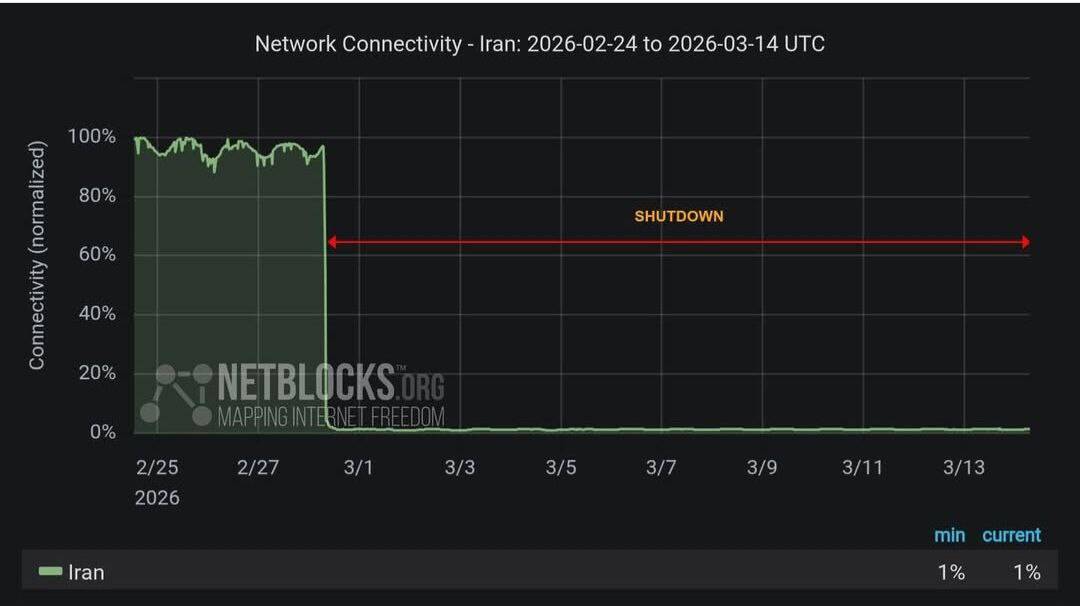
Two weeks have passed since the military attacks on Iran began on February 28, 2026, carried out by Israel and the United States. During this period, cities across the country have been subjected to heavy missile strikes and bombardment. The sound of powerful explosions, combined with a pervasive sense of fear and uncertainty, has become part of daily life—particularly for residents of Tehran, which has borne the brunt of many attacks. Adding to this hardship, the shutdown of international internet access has further isolated the population. As of this report, Iranians have endured two full weeks without global internet connectivity.
The first hours of the strikes against Iran by Israel and the United States were also accompanied by cyberattacks targeting several government websites as well as the state radio and television broadcaster. The Islamic Republic moved quickly to shut down internet access following these initial attacks. Similar measures had previously been taken during the twelve-day war in June and during the widespread protests in January.
This internet shutdown was imposed by Iranian authorities at a time when access to information is absolutely critical for citizens living under bombardment by foreign forces. As a result, many people effectively do not know what is happening around them. They cannot determine which parts of the city have been targeted, which areas have been destroyed, or which neighborhoods are dangerous and should be avoided. They are also unable to follow how events are unfolding or understand the broader developments in the war.
More recently, some Iranians have managed to connect to the internet, albeit briefly and in a limited manner. Although extremely difficult, connections have been possible for a small number of individuals who have attempted to access the internet by testing multiple VPN services—often at very high cost, requiring them to pay significant sums of money. Even then, access has only been possible for short and sporadic periods of time.
“Restore the Internet So We Can Say What We Want Ourselves”
Although calls to restore internet access are often overshadowed by heated debates between supporters and opponents of the war and the military attacks on Iran, reconnecting the country to the global internet has become one of the most urgent demands of Iranians inside the country.
One individual who managed to briefly connect to the global internet from within Iran wrote:
“I managed to connect to the internet with great difficulty only to see that everyone is arguing about what Iranians want. The answer is simple: we want the internet! If we had internet access, we could speak for ourselves about what we want.”
Zia Nabavi, a political activist who has spent more than ten years in prison and who was released only a few months ago from his latest imprisonment, shared the following on an instagram story:
“These days of bombing in Tehran, people’s sense of helplessness, and not knowing when or at what moment bombs may fall, is truly terrifying. The internet is cut off; there is no warning siren to inform the public of when they should remain in their homes or when they should seek shelter. It’s shameful.”
A feminist activist living in Tehran also wrote:
“Nighttime attacks have robbed many of their sleep, and a full night’s rest is rare if not exceptional. Internet access remains shut down. But in the brief moments when we manage to connect, we realize how the calls against the war have been pushed to the margins. Certainly nothing could be worse than for those living under constant bombardment to realize that some of their compatriots are thanking the president of the country that is attacking them.”
One Twitter user wrote:
“The limited connection that was barely available through expensive VPNs seems to be weakening by the moment. Internet access is facing even more restrictions, despite the calls by the public for its restoration.”
The ability to freely communicate, share information and have unfettered access to news is vital during times of war. Yet it is being denied to Iranians who are under heavy bombardment and who could benefit from lifesaving information.
Emily Amraei, a journalist based in Tehran who managed to reconnect to the global internet after a week, wrote the following:
“Cutting off the internet during times of war, is a crime.”
Milad Alavi, another journalist in Tehran, wrote the following in a tweet on March 3:
“The continued internet shutdown in Iran has created a black market for VPNs, with each gigabyte costing between 300,000 and 500,000 tomans. People who are under attack by bombs and missiles, must contend not only with the terrifying rise in food prices, but in order to get a sense of what is happening must also pay money to the VPN mafia. This is our cycle of misery.”
In another tweet on March 4, he wrote:
“This tweet was sent after six hours of trying, testing more than 59 v2ray links, several NPV files, and with the help of a friend using an OpenVPN file. The internet in Iran—both fixed-line and mobile internet—is cut off. We are left in the dark. All the while state television in Iran is telling us that we are on the verge of conquering Tel Aviv and Washington!”
His remarks refer to the highly one-sided reporting currently broadcast by Iran’s domestic media. While people lack access to the internet and independent sources of information, state radio and television present a distorted picture of the war. These broadcasts make no mention of the widespread destruction or the bombardment of Iranian cities and instead focus almost exclusively on reports of “victories” and Iranian attacks.
As a result, people inside Iran, while facing an internet shutdown and satellite signal jamming, are unable to access reliable information about the course of the war, the scale of the bombardments, the extent of destruction, or the number of casualties.
Shima Vezvaei, a journalist in Tehran, also wrote:
“Today most of the people who saw my Instagram stories were outside Iran. The internet has not been restored. Getting a VPN is not like before and the settings are extremely complicated. Stealing people’s right to free connection and communication is nothing less than a war crime. The fact that access is becoming class-based is also a symbol of the massive corruption that has exploded in our faces.”
While 336 hours have now passed since the internet was cut off in Iran, Fatemeh Mohajerani, the Iranian government’s spokesperson, said during a press conference on March 10 that arrangements had been made to ensure internet access for “those who can convey our perspectives to others.”
Her remarks suggest that internet access may be granted selectively to individuals aligned with the policies of the government and the Islamic Republic. Such statements openly point to the policy often referred to as “tiered” or “class-based” internet access in Iran—a policy about which digital rights advocates have warned for years.
Cut Off from Communication: Families Left in Fear
The internet shutdown has not only created widespread difficulties for people inside the country but has also disrupted communication between millions of Iranians living abroad and their families and loved ones in Iran.
At a time when the country is under bombardment and a barrage of reports point to widespread attacks on cities and residential areas, the inability of Iranians based abroad to contact family members and loved ones or to confirm their safety has turned into a nightmare. For them, the experience of war is accompanied by a constant sense of anxiety and fear due to uncertainty about the fate of their loved ones.
Many Iranians based outside the country have elderly parents who remain alone in cities across Iran, with no way for their children to check on their well-being or safety. Some learn through the news that areas close to their families’ homes have been attacked but have no means of contacting Iran to find out whether their loved ones are safe, as international phone service into the country has also been blocked. Only Iranians inside the country can contact their relatives outside–connections that are costly and short.
While the conflict between Israel, the United States, and Iran has spread across the region—Lebanon has also come under Israeli attacks and some Gulf countries have reportedly been targeted by Iranian drones—the only population deprived of access to free information and the global internet however is the people of Iran.
The internet was also shut down during the January protests. At that time, global internet access was cut off nationwide for 180 hours and was believed to be the longest internet blackout in Iran. During that period, even phone calls, text messages, and international communications were severely disrupted, effectively blocking nearly all channels of communication with Iran.
Less than two months later, following massive military strikes on Iran by Israel and the United States, Iranian authorities once again shut down the internet and severely disrupted communication channels. At more than 336 hours of continuous disruption, this blackout represents the longest internet shutdown in Iran to date. Such prolonged shutdowns have become an increasingly common tool used by authorities to control the flow of information during periods of conflict and political crisis.
Internet Shutdowns and International Human Rights Obligations
The widespread and prolonged shutdown of internet access during wartime raises serious concerns under international human rights law and, in many cases, constitutes a clear violation of states’ obligations.
Under Article 19 of the International Covenant on Civil and Political Rights (ICCPR)—to which Iran is a party—everyone has the right to freedom of expression, including the freedom to seek, receive, and impart information and ideas of all kinds, regardless of frontiers and through any media. In the modern world, the internet has become one of the primary means through which this right is exercised.
The United Nations Human Rights Council has repeatedly affirmed that the same rights people enjoy offline must also be protected online. In its 2016 resolution on the promotion and protection of human rights on the internet, the Council explicitly condemned measures that intentionally disrupt or prevent access to the internet and called on states to refrain from such actions.
Beyond restricting freedom of expression, internet shutdowns can also affect other fundamental rights, including the right to life, the right to personal security, and the right to access vital information. In situations where cities are under massive bombardment, access to real-time information about dangerous areas, emergency services, safety warnings, and humanitarian assistance may be critical for the protection of civilians.
UN Special Rapporteurs on freedom of expression have repeatedly emphasized that blanket internet shutdowns rarely meet the standards of necessity and proportionality required under international law. Such measures typically have sweeping and disproportionate consequences, collectively depriving millions of people of their fundamental rights.
Consequently, the ongoing internet shutdown in Iran, particularly at a time when the country is facing war and military attacks, not only prevents citizens from accessing vital information but may also constitute a serious violation of the government’s international human rights obligations.
Key Recommendations to the United Nations and Governments
- Promote peace and accountability – push for an immediate end to hostilities and hold all parties accountable for violations of international law, including targeting civilians or restricting essential services.
- Demand the restoration of internet access – publicly condemn shutdowns as human rights violations.
- Support civil society efforts to monitor the situation and provide internet access– fund independent civil society organizations monitoring the situation and aiming to provide access to the internet for Iranians.
- Embed connectivity in humanitarian action – ensure aid programs maintain safe, open communication channels for civilians.