

Over the past month, Iran has experienced an unprecedented wave of nationwide protests, followed by an extensive and extremely violent crackdown by state authorities. Demonstrations erupted across numerous cities and provinces, driven by deep public anger over political repression, systemic discrimination, economic hardship, and state violence. In response, Iranian security forces launched a broad campaign of suppression characterized by the use of lethal force, mass arrests, internet shutdowns, and widespread intimidation.
Independent media outlets and human rights organizations report that thousands of protesters have been arrested during this period. Many detainees have been held incommunicado, denied access to their families and lawyers, and subjected to ill-treatment, including physical violence, solitary confinement, and coercive interrogations. Revolutionary Courts and security prosecutors have processed protest-related cases at an extraordinary pace, often relying almost exclusively on reports prepared by security agencies.
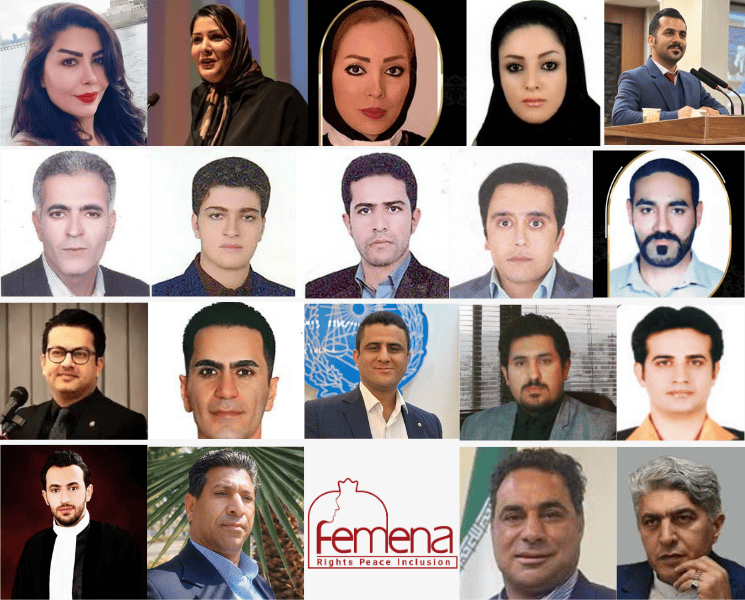
Within this broader context of repression, a deeply alarming and less visible trend has unfolded: the systematic arrest and intimidation of lawyers, particularly those known for their independence or human rights work. Over the past month, at least 19 lawyers have been identified as arrested or detained, according to verified reports, with at least 16 still in detention at the time of writing. The true number is likely higher, given the lack of transparency and the climate of fear surrounding the legal profession.
The arrest of lawyers represents a critical escalation in the state’s response to dissent. By targeting legal professionals, the authorities are not only punishing individual lawyers but also deliberately restricting access to legal defense for thousands of detainees. This report examines the scope and pattern of lawyers’ arrests, the collective response of Iran’s legal community, and the broader implications for the right to defense, the guarantees of a fair trial, and the rule of law.
Arrested Lawyers
At least 19 lawyers, including four women, have been identified by name as arrested during the recent protests, in cities including Tehran, Karaj, Shiraz, Mashhad, and Ivan (Ilam Province). Arrests were frequently carried out at lawyers’ homes or workplaces, sometimes with violence, and in several cases while lawyers were actively engaged in professional duties.
- Shima Ghosheh – Tehran: A prominent human rights and women’s rights lawyer, arrested on 16 January 2026 during a raid on her home. No formal charges were announced, and she has been detained in the 209 ward of Evin Prison.
- Nazanin Baradaran: Her arrest was first publicly reported on Wednesday, 16 January 2026 (26 Dey 1404), by the Islamic Republic of Iran Broadcasting (IRIB) and official state media outlets. However, the exact date of her arrest remains unknown. She was detained in Tehran by the Intelligence Organization of the Islamic Revolutionary Guard Corps (IRGC). Her family has no information regarding her place of detention or the status and progress of her case. State-affiliated Fars News Agency further publicized her arrest in a video report, alleging that Ms. Baradaran was “part of a scenario designed by foreign governments to elevate women figures within the protest movement.” The report also claimed that she had been involved in drafting a legal framework for a post-overthrow period.
- Zohreh Javani: A lawyer and member of the Central Bar Association. She was arrested on 30 January 2026 (11 Bahman 1404).
- Sepideh Taheri: A lawyer and a member of the Hormozgan Bar Association. She was arrested on Sunday, February 1, after being summoned to the Bandar Abbas Prosecutor’s Office.
- Mehran Ansari: Arrested on Wednesday, 28 January 2026 in Shiraz, in front of a courthouse while performing his professional duties.
- Jafar Keshavarz: Arrested on 28 January 2026; no official information has been released.
- Jafar Zarei: A lawyer and member of the Fars Bar Association. He was arrested on Wednesday, 28 January 2026, in Shiraz. The charges against him, the reasons for his arrest, and his place of detention remain unknown at this time.
- Enayatollah Karamati: Arrested on 10 January 2026 and transferred to Vakilabad Prison in Mashhad. He had previously been arrested during the 2022 “Woman, Life, Freedom” protests for supporting demonstrators and detainees. He was later tried on charges of “assembly and collusion against national security” and sentenced to three months’ imprisonment. Earlier this year, the Razavi Khorasan branch of the Judiciary’s Center for Lawyers declined to renew his law license.
- Alireza Farzaneh – Ahvaz: A lawyer and member of the Khuzestan Bar Association. He has been detained since 9 January 2026 (19 Dey 1404) in Ahvaz. There is currently no available information regarding the charges against him, the reasons for his arrest, or his place of detention.
- Masoud Shirmardi Shahghasemi – Tehran: A lawyer and member of the Central Bar Association, was arrested on 9 January 2026 (19 Dey 1404) on Larestan Street in Tehran and transferred to a detention facility in Evin Prison. He has been denied access to legal counsel. During his detention, he has reportedly been subjected to severe beatings and torture. He has not been allowed access to medical treatment for his injuries and is currently at serious risk due to his physical condition. There is no available information at this time regarding the charges against him or the reasons for his arrest.
- Teymour Salari – Jiroft: A lawyer and member of the Hormozgan Bar Association, was arrested on 11 January 2026 (21 Dey 1404) in Jiroft. Since his arrest, he has been held in Jiroft Prison without the right to contact or communicate with his family.
- Amir Bahaderi-Far – Mashhad: A lawyer and member of the Khorasan Bar Association, he was arrested on 10 January 2026 (20 Dey 1404) in Mashhad. No official information has been released regarding the charges against him, the reasons for his arrest, or his place of detention.
- Mohsen Dargi-Nejad – Mashhad: A lawyer and member of the Khorasan Bar Association, was arrested on 10 January 2026 (20 Dey 1404) in Mashhad. There is currently no available information regarding the charges against him, the reasons for his arrest, or his place of detention.
- Dariush Ganjehpour Qashqaei – Fars Province: A legal trainee and member of the Fars Bar Association. At present, there is no available information regarding the date of his arrest or the charges brought against him.
- Hamid Norouzi – Shiraz: A lawyer and member of the Fars Bar Association, he was arrested on 13 February 2026 in front of his home in Shiraz.
- Hadi Sharifzadeh – Shiraz:
A lawyer and Secretary of the Public Relations Commission of the Fars Regional Bar Association, he was arrested on 15 February 2026 at his home in Shiraz. Like Hamid Norouzi, Sharifzadeh was among the signatories of the collective resignation statement issued by several members of the Bar Association in the early days of the protests.
Across cases, common features include a lack of information about charges, restrictions on family contact, and prolonged uncertainty regarding legal status.
In recent weeks, three of the detained lawyers, Mohammad Hadi Jafar-Pour, Mehdi Ansari, and Hossein Shokri, have been released on bail. However, the remaining lawyers remain in the custody of security forces on unspecified charges.
Lawyers’ Statements: A Rare and Historic Collective Response
In response to the escalating repression, Iranian lawyers issued two unprecedented collective statements, marking a rare and courageous moment of public resistance within the legal profession.
The issuance of these courageous statements is particularly significant given the severe security pressures facing lawyers in Iran, many of whom are at risk of arrest, prosecution, or professional retaliation. Speaking out under such circumstances carries serious personal and institutional consequences. Notably, even before broader collective statements were issued, signs of protest had already emerged within bar institutions. On January 3rd, several members of a Fars bar association commission announced their collective resignation in protest against the violent repression of protesters and the erosion of legal standards. This act of resignation was among the first formal institutional reactions within the legal community, signaling deep internal concern about the judiciary’s direction and the handling of protest-related cases.
Subsequently, 108 lawyers issued a separate public statement condemning the unprecedented killing of protesters in Iran. They described the use of lethal force against unarmed demonstrators as a grave violation of the right to life and stressed that those who order or carry out unlawful killings bear individual criminal responsibility. The statement further emphasized that such crimes are not subject to amnesty or statutes of limitations.
In January 2026, 48 lawyers released a detailed statement documenting systematic violations of due process in protest-related cases. The statement describes the denial of access to independent lawyers during the investigation phase, often justified by citing Article 48 of Iran’s Criminal Procedure Code. This provision effectively forces detainees to choose from a limited list of judiciary-approved lawyers, many of whom are widely perceived as lacking independence and failing to provide effective defense.
The 48 signatories further documented a pattern of serious procedural violations, including:
- Summary trials lasting only minutes
- Identical indictments, security reports, and verdicts across multiple cases
- Arbitrary denial of bail and prolonged pretrial detention
- Forced confessions and prolonged solitary confinement
- Denial of medical care
- Prevention of family contact
- Broadcasting of coerced confessions on state media
The statement emphasized that these practices constitute clear violations of the rights of the accused under Iran’s Constitution and the Criminal Procedure Code, undermining fundamental guarantees of fair trial and the right to defense.
The issuance of this courageous statement is particularly significant and historic, given the severe security pressures facing lawyers in Iran, many of whom are at risk of arrest and prosecution themselves. Speaking out under such circumstances carries serious personal and professional consequences.
Taken together, these statements are historically significant. They reflect a collective refusal by segments of Iran’s legal community to legitimize systemic violence and judicial abuse, despite the substantial risks involved.
The Note to Article 48 of Iran’s Criminal Procedure Code
This repression is further institutionalized through the use of the note to Article 48 of Iran’s Criminal Procedure Code. Under this provision, defendants in certain cases, particularly those labeled as “national security”, are required during the investigation phase to select their lawyer from a judiciary-approved list.
While the law formally limits this restriction to the prosecutor’s stage, in practice, its application has expanded far beyond its stated scope. Some branches of the Revolutionary Courts, most notably Branch 15 of the Tehran Revolutionary Court and Branch 1 of the Karaj Revolutionary Court, have unlawfully extended this limitation to the trial phase. Independent lawyers have been barred from attending hearings altogether, despite the absence of any legal basis for such exclusion. This practice represents a serious distortion of the law and a direct violation of the right to defense.
For years, independent lawyers in Iran have warned that the note to Article 48 constitutes a dangerous deviation from fundamental principles of criminal procedure. They have described it as a structural barrier to meaningful defense, particularly in politically sensitive cases, and have cautioned that it institutionalizes inequality before the law.
Numerous reports further indicate that many Article 48 lawyers maintain close ties to security institutions and frequently fail to provide effective legal representation. In protest-related cases, common practices have included advising defendants to avoid media attention, discouraging families from publicizing cases, urging detainees to accept charges, or recommending that they seek pardon or clemency rather than challenge the legality of the proceedings.
In some instances, these lawyers reportedly invoke their proximity to security bodies to persuade families that retaining independent or human rights lawyers would be ineffective or counterproductive. Such dynamics pressure families into foregoing independent representation at a critical stage of the process.
Why Are Lawyers Being Arrested?
The arrest of lawyers is not an isolated or reactive measure. It forms part of a deliberate strategy to dismantle access to effective legal defense in protest-related cases.
Independent and human rights lawyers in Iran already operate under intense pressure, including surveillance, disciplinary action, and prior imprisonment. By arresting lawyers who represent, or signal willingness to represent, protesters, authorities seek to remove experienced and independent defenders from the legal system. These arrests also serve to intimidate other lawyers and discourage them from accepting protest-related cases.
At the same time, by restricting defendants to a judiciary-approved list of lawyers, many of whom are perceived as being close to security institutions, the authorities further obstruct the documentation of torture, coerced confessions, and procedural violations.
****
The arrest of lawyers during Iran’s recent protests reflects a systematic effort to criminalize legal defense and dismantle one of the last remaining safeguards against state abuse.
Independent defense lawyers and human rights attorneys in Iran, particularly those who represent political dissidents, protesters, and government critics, have long operated under constant threat of arrest, prosecution, license suspension, and judicial harassment. Taking on politically sensitive cases frequently exposes lawyers themselves to criminal charges, travel bans, surveillance, and security pressure. In this environment, legal advocacy becomes a personal risk.
Even before the most recent wave of protests, numerous lawyers had already been subjected to politically motivated prosecutions and imprisonment. According to a report published in May 2025 by the Center for Human Rights in Iran, 66 human rights lawyers were arrested in the aftermath of the “Woman, Life, Freedom” movement solely for performing their professional duty, defending defendants. The report further documented that over the past decade, at least 50 human rights lawyers have faced state persecution, harassment, or prosecution in connection with their legal work.
Among those imprisoned even before the current protests is Mohammad Najafi, who has been serving a cumulative 17-year prison sentence since 2018 due to his human rights activities and defense of politically sensitive cases. Another example is Mohammadreza Faghihi, who has been imprisoned since 22 January 2025 to serve a five-year sentence. These cases illustrate that the targeting of lawyers is not a temporary response to unrest but part of a sustained pattern.
The government’s policy of harassing and prosecuting human rights lawyers serves multiple purposes. It instills fear within the legal profession, discourages other attorneys from taking on politically sensitive cases, and deprives protesters and dissidents of meaningful legal representation. More broadly, it is a strategy aimed at producing isolation and helplessness, sending a message that even access to legal defense is precarious and conditional.
For years, lawyers and human rights organizations have called for concrete reforms, including abolishing the requirement that political defendants use only state-approved lawyers; enforcing constitutional prohibitions against torture and forced confessions; ending judicial practices that allow appellate proceedings to take place without the presence of defendants and their counsel; and curbing the pervasive influence of security institutions over the judiciary. The Islamic Republic has not heeded these demands. Instead, it has escalated pressure on independent lawyers, steadily raising the personal, professional, and legal costs of defending government critics. In doing so, it has deepened a system in which legal defense itself is treated as a threat to state authority.
Recommendations to the International Community
1. Demand the Immediate Release of Lawyers, Human Rights Defenders and Protesters, Detained “in Connection with the Protests and the Repeal of All Execution Sentences
The international community should urgently and unequivocally demand the immediate and unconditional release of all individuals imprisoned as a result of the recent protests. This includes protesters, human rights defenders, lawyers, journalists, and others detained solely for exercising their fundamental rights. At the same time, states and international bodies must demand the immediate repeal and suspension of all death sentences issued in connection with protest-related cases, recognizing that these sentences have been imposed following grossly unfair proceedings, coerced confessions, and systematic denial of due process.
2. Establish International Monitoring and Rapid Response Mechanisms for Lawyers at Risk
International bodies, including UN Special Procedures and regional legal associations, should establish emergency monitoring mechanisms specifically focused on the arrest, detention, and prosecution of lawyers in Iran. This should include rapid-response public statements, trial observation mandates, and direct engagement with Iranian authorities when lawyers are detained.
3. Condition Diplomatic Engagement on Respect for the Right to Legal Defense
States engaging diplomatically with Iran should make respect for the independence of lawyers and access to counsel a clear benchmark in bilateral and multilateral relations. The release of detained lawyers and the cessation of prosecutions related to legal work should be raised consistently in diplomatic forums.
4. Support Independent Legal Representation Through Protection and Documentation
International organizations should provide support—technical, legal, and protective—to independent Iranian lawyers and legal networks, including documentation of violations against defense counsel and preservation of evidence for future accountability processes.
5. Demand Repeal or Suspension of the Note to Article 48
The international community should explicitly call for the repeal or suspension of the note to Article 48 of Iran’s Criminal Procedure Code, recognizing it as incompatible with international fair trial standards and a structural mechanism enabling abuse and denial of the right to defense.
Download the PDF file: