

Key Developments
- Nationwide protests have entered their 20th day amid intensified use of lethal force.
- As of January 19th, 2026, at least 3919 deaths (3685 protesters, 25 children, 31 civilian bystanders and 178 military/government officials) and over 24000 arrests, have been verified and documented.
- Internet shutdown continues, severely restricting verification and information flow.
- Credible reports indicate mass casualties at Kahrizak forensic facility.
- Families face coercion, extortion, and pressure to falsify circumstances of death.
- Forced confessions, including of children, are being broadcast by state media.
More than twenty days have passed since the outbreak of nationwide protests in Iran. At the same time, the country has experienced a near-total internet shutdown for over a week, severely restricting public access to information and communication with the outside world. In the early hours of Saturday, data from NetBlocks indicated a temporary increase of approximately two percent in international internet traffic. Only a very limited number of users were able to briefly access the internet—primarily through circumvention tools—and posted short messages on social media platforms such as X, largely to confirm that they were alive and relatively safe.
According to messages emerging from inside the country, those briefly reconnected reported an unprecedented level of violence on the streets. Many described the scale of killings, the number of injured protesters, and the extent of bloodshed in public spaces as far exceeding anything witnessed during previous protest movements.
Information limitations: Due to the ongoing internet shutdown, severe restrictions on independent reporting, and fear of reprisals, information from inside Iran remains extremely limited. All figures on numbers of those killed or arrested should therefore be understood as minimum estimates, with the actual scale of violations likely significantly higher.
By January 19, which marked the twenty second day of protests, the Human Rights Activists News Agency (HRANA) reported that it had verified at least 3685 protesters, 25 children, 31 civilian bystanders and 178 military/government officials, who had been killed. The same source reported more than 2,107 injured and over 24,000 arrests nationwide. HRANA has also documented at least 145 cases of forced confessions broadcast by state-affiliated media to date. It should be noted that given the high death tolls, internet shutdowns and the securitized environment, the process of collecting data and verifying deaths and human rights violations is difficult and slow. In the days to come, the numbers of those killed and arrested will indeed change, and will likely increase considerably.
Eyewitness Accounts
Limited contact with individuals inside Iran suggests that the true scale of killings and repression is significantly greater than what has so far reached international media. “Multiply everything you have seen or heard,” was a recurring message shared by users who briefly regained internet access in the early hours of Saturday after a week-long blackout.
One informed source told Femena:
“The streets look like a war zone. Everything is burned—shops, banks, ATMs, trash bins. There are visible traces of blood, and the scale of killing has been so high that the evidence has not yet been cleared. Multiply everything you have heard.”
A journalist in Tehran told Femena:
“Almost everyone we know has someone close to them who has been killed, injured, or shot in the eye.”
The journalist further reported that a close friend of a colleague was killed, and authorities demanded approximately USD 9,000 from the family to return the body. The family, unable to afford the payment, reportedly said they would mourn at an empty grave rather than receive the body.
Crisis at Kahrizak Forensic Center
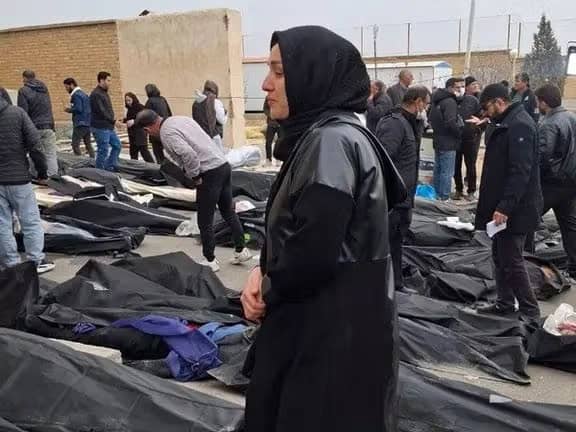
A senior official from Iran’s Legal Medicine Organization stated in a televised interview that the Kahrizak forensic center in Tehran had been overwhelmed by the number of bodies. According to the official, all four storage halls were filled, forcing families to personally search through hundreds of bodies to identify their loved ones. The official acknowledged that several hundred corpses—most killed on Thursday, January 9—remained unidentified until Tuesday, January 13.
In a related development, Forensic Architecture reviewed video footage from the Kahrizak facility and estimated that at least 298 bodies were visible in the footage analyzed.
Pressure on Families and Security Narratives
Another journalist in Tehran reported to Femena that some families seeking the bodies of their children were presented with two options: either declare that their child had been a member of government forces—thereby being classified as a “martyr”—or identify three individuals as the perpetrators and request retribution. According to this source, the names of these individuals were provided by security forces and are likely detainees from the protests. This practice appears aimed at attributing the killings to “terrorist groups” and constructing a narrative that could later be used to justify executions.
Detainees and Forced Confessions
Reports indicate that the number of detainees has surpassed 22,000, with at least 145 forced confessions aired on state or state-affiliated media. In these videos, detainees often repeat identical claims, alleging they were paid by groups outside Iran to participate in violent protests. In one such video, a woman claims she personally sent a message to Israeli Prime Minister Benjamin Netanyahu.
In another video broadcast in the early days of the protests—prior to the internet shutdown—two girls aged 14 and 16 were shown confessing on camera that they had joined the protests in exchange for five million tomans (approximately USD 50). Femena’s ongoing investigation into forced confessions, to be published separately, indicates that these statements lack logical coherence and clearly reflect scripted narratives imposed by interrogators, often extracted under coercion and promises of release.
At present, little information is available regarding prison conditions or the treatment of detainees. The scale of fatalities and the continued internet blackout have shifted public attention toward the killings, while thousands remain in detention across the country. Many face serious charges that could result in severe sentences, including the death penalty.
A report published by the Shargh newspaper on Sunday, January 11, during the internet shutdown, described the distress and confusion of families searching for detained relatives outside courts, police stations, and prisons in Tehran Province. The report indicates that hundreds of detainees in Tehran have been transferred to Evin, Fashafuyeh, and Qarchak prisons, with many denied contact with their families for days following arrest.
Continued Internet Shutdown
The brief reconnection of a small number of users early Saturday, January 16th raised hopes that internet access was being restored. The state-affiliated Fars News Agency reported that internet access would be restored in phases—beginning with SMS services, followed by access to the national intranet, and eventually international connectivity. In contrast, Filterban, which monitors internet access in Iran, warned that authorities are rapidly implementing systems and regulations that could structurally disconnect Iran from the global internet.
Conclusion
The limited yet deeply alarming information emerging from Iran amid the ongoing internet shutdown indicates that the repression of nationwide protests has entered a new and unprecedented phase of organized violence. Continued communication blackouts, concealment of the true scale of killings, pressure on families to distort the truth, and the growing number of arrests and forced confessions constitute serious and widespread human rights violations.
Without urgent international scrutiny, there is a serious risk that the current wave of repression will escalate into further mass killings and expedited executions in the days and weeks ahead. In this context, unhindered access to information and independent international monitoring are more critical than ever.
Femena will continue to closely monitor developments and publish verified updates as information becomes available.